Here you will find brief explanations of topics that interest customers the most:

The contractual partner of AS Gaasivõrk in the provision of e-service is AS Elenger Grupp. We ensure that your personal data are protected and only use them to the extent necessary.
ContinueHere you will find brief explanations of topics that interest customers the most:

Network service within the meaning of the Natural Gas Act is the provision of the natural gas transmission or distribution service via the network.
Elering AS provides gas transmission services and transports gas in the transmission network from the Estonian border to distribution system operators and customers directly connected to the transmission network.
The distribution system operator provides the gas distribution service and ensures that the gas is delivered to customers connected to the distribution system operator’s network.
AS Gaasivõrk, which belongs to the Elenger Group, is the largest gas distribution system operator in the Republic of Estonia, managing 1500 km of distribution networks and ensuring the availability of gas for customers at nearly 45 thousand consumption points connected to the distribution network of AS Gaasivõrk. There are more than twenty distribution system operators in Estonia.
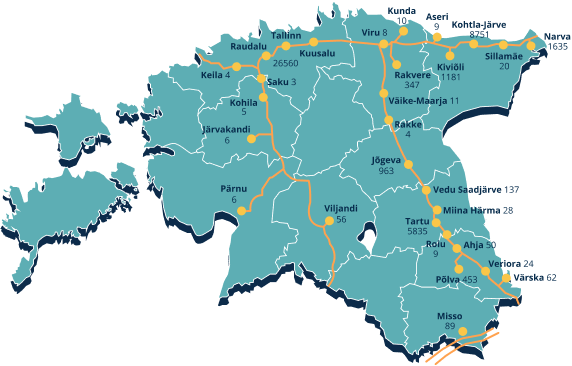
* The number of measurement points is approximate, as it changes on a daily basis.
The provision of the network service does not include the sale of gas to the customer. In order to buy gas, the customer must sign a sales contract with a gas seller. Gas is sold according to the conditions established by the gas seller. If the customer does not have a valid gas sales contract, the gas seller named by the network operator will be deemed to be the seller of the gas consumed by the customer during the given period. The gas seller named by AS Gaasivõrk is AS Elenger Grupp.
In Estonia, the gas market is regulated by the Natural Gas Act, which sets out the requirements for the importer, transmitter, seller and distributor of gas as well as for the Competition Authority that exercises supervision over the market. Network operators in Estonia are also regulated by the Competition Authority, which ensures that prices and conditions for network services are fair and transparent.
Biomethane is a local renewable fuel that meets the quality requirements of natural gas, containing over 97% methane (CH4). Biomethane is produced by purifying biogas to remove carbon dioxide (CO₂) and other unnecessary compounds. Biomethane can be used wherever natural gas is used.
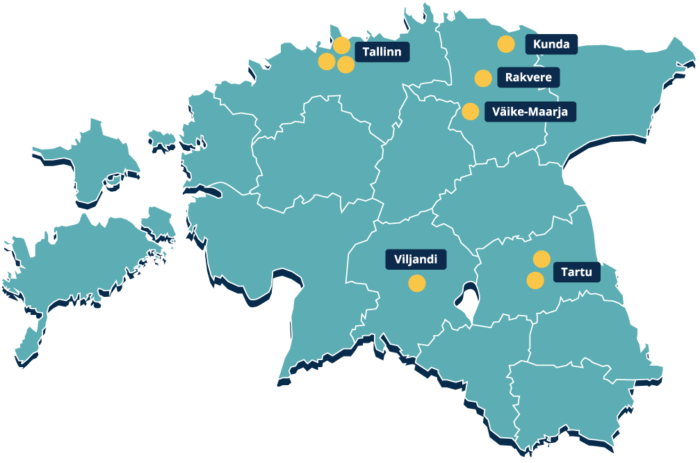
Biomethane has been injected into the distribution network of AS Gaasivõrk at nine different entry points.
Remote gas meters make it possible to record readings remotely. This means that the readings are sent to us automatically and you no longer need to provide us with a monthly reading. Remote gas meters measure the quantities of gas consumed to the nearest hour and transmit information on the quantities of gas consumed once a day. The meters use mobile communication to transmit information. We install remote gas meters at the measuring point through which at least 750 m3 of gas is consumed from the network operator’s network per year. You can see the quantities you have consumed in our e-service.
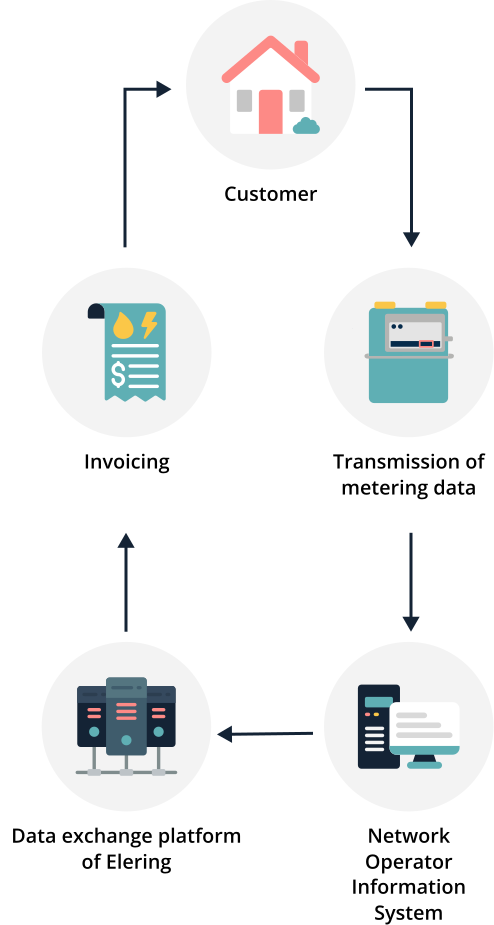
Customer – The customer consumes gas and the meter at the point of consumption measures the quantities and transmits the metering data to the network operator’s information system by remote reading.
Transmission of metering data – The remote gas meters transmit the metering data of the quantities of gas consumed once a day via air to the information system of the network operator.
Network Operator Information System – After the metering data is received, the network operator’s system validates the data and if the metering data could not be transmitted due to technical reasons, also forecasts the consumption data, if necessary. The validated data will be transmitted to the data exchange platform of AS Elering.
Data exchange platform of Elering – The Elering data exchange platform collects all the consumption data of all customers and makes them visible to both gas sellers and customers.
Invoicing – Monthly invoices are generated on the basis of the consumption data on the Elering data exchange platform. The network service invoice of AS Gaasivõrk is sent to the customer via AS Elenger Grupp, which is our contractual invoicing partner.
Customer – As a result of all this, the customer will conveniently receive an accurate invoice and information on their consumption in the previous period.
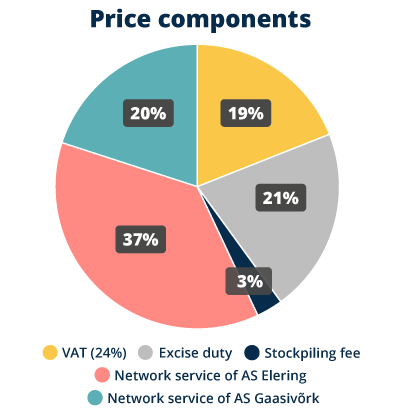
The invoice for the gas network service generally consists of five components: the largest part of the invoice is the network service of Elering AS, followed by excise duty, the network service part of AS Gaasivõrk, VAT and the stockpiling fee for the gas reserve. The other fees related to the provision of the service may also be added to the invoice.
All gas sellers can submit joint invoices for network services and gas to their customers. If your gas supplier has chosen to submit joint invoice, you will not receive a separate invoice for the network service from the network operator, but you can pay for the gas you used and the network service at the same time.
Elenger Grupp AS has chosen to submit joint invoices.
Gas sellers can join the joint invoice service by contacting AS Gaasivõrk.
What is the purpose of the new pricing model?
The new pricing model accounts separately, within the network fee, for both the quantity of gas consumed and network availability. Therefore, depending on the price group, the network fee consists of a consumption-based fee and either a fixed fee or a capacity-based fee.
Which metering point belongs to KODU price group?
KODU price group includes a metering point for which the network contract has been concluded by a private person, an apartment association or a gardening association.
How is belonging to ÄRI price group determined?
If a metering point does not belong to KODU or SUVI price group, it is assigned to ÄRI S, ÄRI M or ÄRI L price group on the basis of its calculated capacity:
| Price group | Calculated capacity of the metering point |
| ÄRI L | is equal to or greater than 10,000 m³/h. |
| ÄRI M | is from 1,000 m³/h to 9,999 m³/h (inclusive). |
| ÄRI S | is less than 1,000 m³/h. |
How is the calculated capacity of a metering point determined?
As a rule, calculated capacity is determined on the basis of hourly metering data from the preceding three calendar years. The highest actual hourly consumption during that period is used. Calculated capacity is not a separate fee, it is the basis for calculating the capacity-based fee.
When is a metering point assigned to SUVI price group?
A metering point is assigned to SUVI price group at the customer’s request if at least 80% of consumption takes place between 1st of May and 31st of October and the consumption data confirm the seasonal use of the metering point.
Does SUVI price group have to be applied for again every year?
No. SUVI price group applies for as long as the metering point meets its conditions or until the customer requests a change of price group.
How is the network fee calculated for a metering point in KODU price group?
The network fee for a metering point in KODU price group consists of a fixed fee and a consumption-based fee.
The fixed fee is payable every month during the term of the network contract, even if no gas is consumed. If the network contract is valid for only part of a month, the fixed fee is calculated pro rata according to the number of days for which the contract is valid. The fixed fee is EUR 5.90 per month excluding VAT, i.e. EUR 7.32 per month including VAT.
The consumption-based fee depends on the quantity of gas consumed at the metering point:
quantity consumed (kWh) × consumption-based price (EUR/kWh) = consumption-based fee (EUR)
How is the network fee calculated for a metering point in ÄRI or SUVI price group?
The network fee for ÄRI or SUVI metering point consists of a capacity-based fee and a consumption-based fee.
The capacity-based fee is calculated on the basis of the calculated capacity of the metering point:
calculated capacity (m³/h) × capacity-based price (EUR/m³/h/month) = capacity-based fee (EUR/month)
The consumption-based fee is calculated on the basis of the quantity of gas consumed at the metering point:
quantity consumed (kWh) × consumption-based price (EUR/kWh) = consumption-based fee (EUR)
Is the capacity-based fee payable for ÄRI or SUVI metering point even if no gas is consumed?
Yes. The capacity-based fee is also payable in a month with no consumption because the network connection and the required capacity are kept available for the customer.
What happens if hourly metering data for three calendar years is not available?
For a new metering point, calculated capacity is determined on the basis of the available hourly metering data, provided, that the data is available for at least 12 consecutive billing periods and reflect the normal use of the metering point.
If sufficient hourly metering data is not available, the maximum permissible hourly quantity agreed in the network contract is used as the basis.
Calculated capacity is determined as an integer and may not be less than 1 m³/h.
What happens if actual consumption is significantly lower than the maximum permissible hourly quantity agreed in the network contract?
If the highest actual hourly consumption is less than 50% of the agreed maximum permissible hourly quantity, 50% of the agreed maximum permissible hourly quantity is used as the calculated capacity. For example, if the maximum permissible hourly quantity agreed in the network contract is 120 m³/h but actual consumption is 30 m³/h, then the calculated capacity will be 50% of the maximum permissible hourly quantity agreed in the network contract, i.e. 60 m³/h. If the customer wishes the calculated capacity in such a situation to be 30 m³/h, a change in the consumption regime must be initiated, i.e. an application must be submitted to reduce the maximum permissible hourly quantity in the network contract.
When are the calculated capacity and price group reviewed?
During the first implementation period of the new pricing model, the determined calculated capacity and price group apply from 01.09.2026 to 31.03.2027.
Thereafter, the price group and calculated capacity are generally determined at the beginning of each year, and the customer is notified of them at the beginning of January. The price group and calculated capacity apply from 1st of April of the same year to 31st of March of the following year.
The price group or calculated capacity may also change during the year, if the circumstances, on which its determination is based, change.
Can the customer request a review of the price group or calculated capacity?
Yes. In justified cases, the customer may request a review of the price group or calculated capacity of the metering point.
AS Gaasivõrk reviews the application within 30 calendar days after receiving all necessary information and may request additional information or documents if necessary.
What should be done if the highest hourly consumption resulted from an exceptional situation?
If the highest hourly consumption resulted from a metering error, accident, malfunction or another exceptional circumstance and does not reflect the normal capacity requirement of the metering point, you may request a review of the calculated capacity. Please describe the circumstances in the application and, where possible, include supporting data.
Does the network contract need to be re-signed in order to determine the price group or calculated capacity?
No. The annual determination of the price group and calculated capacity does not require re-signing of the special terms and conditions of the network contract.
If the maximum permissible hourly quantity agreed in the contract is changed, a corresponding agreement is concluded.
What happens if the customer has several metering points?
As a rule, the price group, calculated capacity and network fee are determined separately for each metering point. Consequently, a single customer’s metering points may belong to different price groups.
As an exception, summarised data for the metering points are used where, for technical reasons, several metering points supply the same functionally interconnected customer installation or network.
Does the change in the pricing model affect the gas sales contract concluded with the gas seller?
No. The change concerns only the network service provided by AS Gaasivõrk and does not apply to the gas sales contract concluded with the gas seller or the sale price of gas.
Can the capacity-based fee be avoided by terminating the network contract or reducing the maximum permissible hourly quantity?
The termination of the network contract or a reduction in the maximum permissible hourly quantity must correspond to an actual change in the customer’s needs.
If the maximum permissible hourly quantity is increased within 12 months after it was reduced, or if a business customer requests the resumption of use of the network connection at the same location within 12 months after the termination of the network contract, AS Gaasivõrk may, under the conditions set out in the standard terms and conditions of the network contract, make a corrective calculation of the capacity-based fee. A corrective calculation may also be made if, after the hourly quantity has been reduced, the customer breaches the agreed consumption regime.
Do I have to submit the readings?
If the point of consumption does not have a remote gas meter, the reading of the gas meter must be submitted as an integer from the 26th day of the metering period until the first working day of the following month.
Customers of other network operators must submit the reading to the network operator in their area.
The reading of the remote meter does not have to be submitted, unless otherwise indicated by the network operator.
How do I get the reading?
The reading of the meter that is read on the spot must be submitted as an integer.
The reading of the remote meter does not have to be submitted, unless otherwise indicated by the network operator.
Guide for remote gas meters
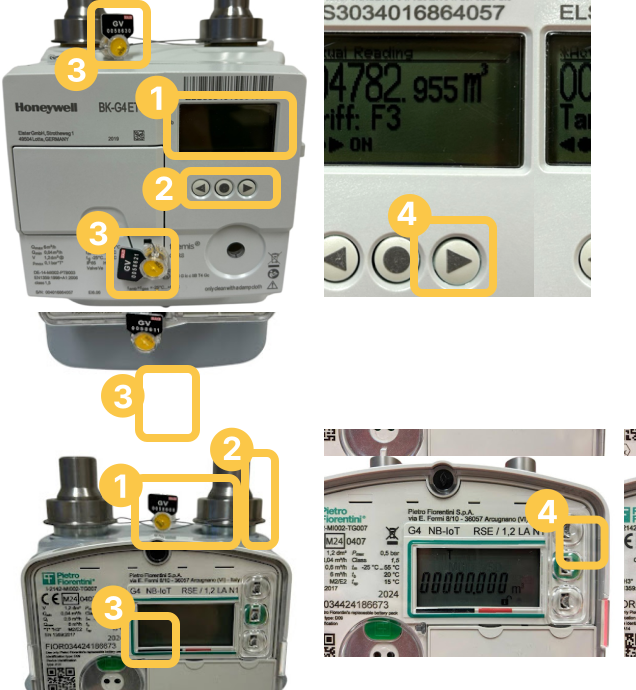
In order to turn on the meter screen, press the button marked with a circle (Figure 4) and the reading will appear on the screen.
The reading displayed on the screen in large digits is used for billing. The small numbers are not used.
In order to turn on the meter screen, press the button marked with a circle (Figure 4) and the reading will appear on the screen.
The reading displayed on the screen before the point is used for billing. The numbers after the point are not used.
Old gas meters are being replaced
AS Gaasivõrk is replacing old remotely readable gas meters of its customers with a new generation of remotely readable gas meters. By 2030, the company plans to replace approximately 15,000 meters in total.
The purpose of the meter replacement is to ensure the reliability of measuring devices and the uninterrupted operation of gas supply.
The work is carried out by a partner of AS Gaasivõrk. The replacement of the meter is free of charge for customers. During the work, there will be a short interruption in the gas supply.
AS Gaasivõrk will send its customers a prior notification about the gas meter replacement via email, after which the company’s partner will contact the customer by phone and email to agree on a suitable time for the replacement.
IMPORTANT!
Representatives of AS Gaasivõrk and its partners always carry an identification card with a photo.
Neither AS Gaasivõrk nor its partners will ask customers for bank card details, PIN codes, or other sensitive personal data in connection with the meter replacement.
For questions or additional information, please contact AS Gaasivõrk customer service at 6600009.
Gas metering reminder
Where does gas come from?
There have been significant changes in the supply of gas to Estonia, and gas supplies from Russia to our region (the Baltic States and Finland) have been completely disrupted.
Gas enters our region’s gas network from Western countries such as Norway, the United States and others. Gas is brought in by ships and introduced into the gas network via LNG regasification terminals, for example from Klaipeda in Lithuania or Inkoo in Finland. The Inčukalns gas storage facility in Latvia is also filled with gas that has arrived in the region via LNG terminals.
Increasingly more green, environmentally friendly biomethane is also entering the Estonian gas grid.
What should I do if I don’t have gas?
If there is no gas for any reason, you must call 13404.
What is the gas reserve stockpiling fee?
The state has stockpiled a strategic gas reserve in an underground gas storage facility in Latvia that can be used in the event of an emergency. In addition, the state has built a hailing quay at the LNG terminal in Paldiski, which can supply the Estonian gas network with LNG from ships.
The costs of managing the strategic gas reserve and the hauling quay and infrastructure of the LNG terminal are covered by the fee for the strategic gas reserve and the hauling quay and infrastructure of the LNG terminal, i.e. the stockpiling fee.
The stockpiling fee is collected from consumers by the network operator that pays the collected fee to the manager of the reserve, i.e. Eesti Varude Keskus.
Boiler maintenance
Gas boilers and gas water heaters must be serviced regularly, preferably once a year, as unmaintained equipment can lead to higher energy costs and accidents. The maintenance service must be ordered from a reliable licensed company.
(Mon-Fri 8.30-17.00)
naidud@gaas.ee